The Other Side of Nashville leads you to believe, during the opening scene, that the movie is going to be about honky-tonk singers who are struggling to make it in Nashville. The movie then takes a turn with a host of stars bemoaning the fact Country Music has become too citified. Even Chet Atkins, who helped create "The Nashville Sound" joins the chorus. What The Hell....the man who was instrumental in pushing out "real" country music in order to line his own pockets with money, NOW, or at least in 1983 when this movie was made, thinks country has lost its roots. Maybe it goes back to the old saying "You don't miss your water, till the well runs dry".
As each of the country artists (most who would now (2011) fall into the category of Alt, Outlaw, or Americana) give their take on what's wrong with country music, the movie features song performances from that artist or the artist they are discussing. Musicians interviewed or in performance clips featured in The Other Side of Nashville include: Willie Nelson, Bobby Bare, Johnny Cash, Charlie Daniels, Emmylou Harris, Hank Williams Jr., Chet Atkins, Kris Kristofferson, Carl Perkins, Kenny Rogers, Ricky Scaggs, Terri Gibbs, Gail Davis, Jerry Reed, Porter Wagoner, Charlie McCoy, Rattlesnake Annie, and Bob Dylan.
Near the end of the movie, the point of the movie changes direction again, when Willie Nelson says "Music is Music", no matter who is making it, that all musicians have a similar outlook on what they are doing. The Other Side of Nashville then goes back to some of the artists who now contradict their earlier statements and seem to agree with Willie. I realize the movie was edited this way, still it was odd seeing this turnaround.
The movie returns to the honky-tonk from the first of the film and ends with Owen Davis singing his song "The Other Side of Nashville". I never could quite grasp what point The Other Side of Nashville was trying to make, since it kept changing directions. On the other hand, it was an enjoyable film due to all of the song performances. And where else are you going to see/hear a movie narrated by Bob (Is It Running, Bob?) Johnston.
I've only seen a couple of biopics in which the lead actor was so able to meld their own personality with the subject they were portraying, they made it hard for me to see where one person ended and the other began. This was the case with Sissy Spacek in Coal Miner's Daughter, Gary Busey in The Buddy Holly Story, and adding to the list is Joaquin Phoenix in Walk The Line.
Walk The Line starts with Johnny Cash (Joaquin Phoenix) preparing to go on stage at Folsom Prison. When Johnny sees a table saw, it reminds him of the death of his older brother Jack and the movie flashes back to that traumatic event in 1944. The film then moves Johnny into adulthood with his service in the Air Force, where at an on-base showing of a documentary about Folsom Prison, Johnny gets the idea for one of his most famous songs, "Folsom Prison Blues".
Johnny returns to the United States, gets married, and has a very unsuccessful career as a door to door salesman. He forms a gospel band on the side, and when they finally get a chance to record at Sun Studios, things are a bust when they sing Sam Phillips a gospel song. Johnny mentions that he has a song he wrote and when he plays it for Phillips....as the old saying goes "it's history in the making".
During his early years we see Johnny on tour with Jerry Lee Lewis, Roy Orbison, and even the king himself, Elvis Presley. [A side note: Waylon Payne plays Jerry Lee in this film, the last time I saw Waylon Payne he was playing Hank Garland in Crazy....I kept thinking I was watching Waylon Payne playing Hank Garland playing Jerry Lee Lewis]. On one of these tours, Johnny's path crosses with June Carter's (Reese Witherspoon) and he is smitten from the start. Too bad for Johnny, because June won't have anything to do with a married man. Also, on these tours we see Johnny getting hooked on pills, explaining why he always wears black (Johnny: "Couldn't Find Anything Else") and where he came up with his sound (Johnny: "We'd play faster if we could"). Walk The Line continues showing us parts of Johnny Cash's life back up to his performance at Folsom Prison.
Other musicians of note in Walk The Line: Shooter Jennings has a couple of brief appearances playing his own dad, Waylon Jennings. Sandra Ellis Lafferty, as Mother Maybelle Carter, has a great scene when the family is trying to get Johnny off drugs and she chases a drug dealer away with a shotgun. Shelby Lynne plays a very convincing role as Johnny's mother in the early part of the movie.
One final small thing to look for in Walk the Line, right before Johnny decides to play Folsom and record a live album there (even though the record company didn't think it was a good idea) he's looking through a box of prisoners' letters. If you look closely, one of them is from Folsom prisoner Glen Sherley. This is the man who wrote Johnny's song "Greystone Chapel" about the chapel at Folsom Prison.
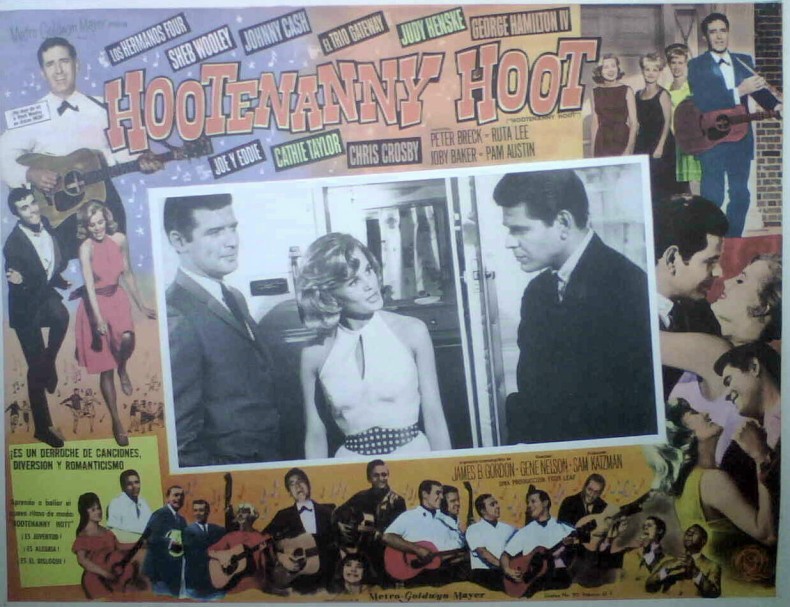
Just as Rock n Roll and Country Music were exploited by the movie companies, in Hootenanny Hoot (HH), Folk Music gets the same treatment: Very brief plot that surrounds the musical performances.
HH begins with Peter Breck (The Big Valley) trying to shoot a TV show, we quickly find out that his ex-wife, Ruta Lee, is the producer and she has other ideas on how the show should be shot. In a huff, Peter quits and says he's going to drive to the coast - somehow we next see him in Missouri!
In Missouri he happens on a preview of a Hootenanny that is going to be given later that night at a local college.....Start cueing musical performances, as we get our first two acts - The Gateway Trio singing "Puttin' On The Style" and George Hamilton IV singing his hit "Abilene". Peter walks around like some big city asshole smoking his pipe and checking out all of the rubes and is amazed at how the crowd is digging these acts. Overall, he seems to be mainly interested in checking out a co-ed played by Pam Austin, which is a little creepy since he appears to be at least fifteen years older than her.
Peter follows Pam to the college and catches a rehearsal with Johnny Cash singing "Frankie's Man Johnny". Johnny looks much healthier here than he did four years later in Road To Nashville. In this scene Pam Austin is wearing an outfit, and since the movie is in black and white, it gives her the appearance of being nude (maybe this is why Peter keeps following her!). Peter wants to know exactly what a "hootenanny" is and he's told it's Folk and Country Music and Dancing. There are several dance numbers in HH, but I'm old enough to actually have attended a Hootenanny back in 1962 or 1963 and I don't remember any dancing, just a flat bed truck with straw on the floor and people singing such songs as "If I Had A Hammer".
Peter calls his agent, played by Joby Baker, and wants him to come and check things out in Missouri. Peter tells Joby that there's money to be made with these country and folk singers because people in the middle of the country (what we now call Blue States) are crazy for this type of music. He thinks he can sell it to TV and put on a weekly Hootenanny. This was an odd part of the movie, since in a movie exploiting music, we have a plot point about exploiting music.
Joby attends the Hootenanny that night with Peter and the movie has performances by Joe and Eddie singing "There's A Meeting Here Tonight", Cathie Taylor singing a humorous number "The Frozen Logger", The Brothers Four singing "Frogg" and Sheb Wooley singing the title song. Surprisingly, The Brothers Four each get to have a line of dialogue as Peter tries to convince them, along with the other acts, to break their Hootenanny contracts and do his TV show. At the same time Joby has reported back to Ruta, who is just in a tizzy about what is going on with Peter. Also, Joby accuses Pam Austin of only being interested in Peter for the purpose of furthering her career.
We get a scene the next day beside a river, that looked suspiciously like the one I had seen in College Confidential, so I'm assuming it was on a studio back lot. At the lake, Chris Crosby (son of Bob, nephew of Bing) has one of the better songs in the movie: "Sweet Love". It probably would have been the best song in the movie, except he's followed by Judy Henkse singing "The Ballad of Little Romy". Judy is such a strong performer, she really trounces everyone with this performance and her later performance in the movie. Judy also gets a line of dialogue, maybe that was repayment for having to sing in her bathing suit!
Joby and Pam have found they have an attraction to each other, but Joby won't double cross his friend Peter who is back in New York trying to sell a Hootenanny on tour show and not having any luck. Once he's back in Missouri (the Hootenanny performers were supposed to be too busy to do a TV show, but they sure hang around the same town a long time) he finds Pam in love with Joby and Ruta is now in town also. Peter accepts the relationship between Pam and Joby, but is still cold toward Ruta.
The network agrees Peter can put on a special and if they like it, the network IBS (I'm guessing it stood for International Broadcasting System and NOT Irritable Bowel Syndrome!) will give him a permanent show. The network president also gives him an order that is my favorite line from the movie " None of that coffee house jazz with Beatniks flopping over each other", instead the show must have an Americana theme and be on a specific date. This causes problems for Peter, but luckily he finds a circus that he can co-book with and puts on the "All American Hootenanny Circus". We get Sheb Wooley singing "Building A Railroad" while some shirtless guys bang anvils, followed by The Gateway Trio on a trampoline (I"M NOT MAKING THIS UP!) singing "Foolish Questions", Judy Henkse doing a powerhouse of a song with "Wade In The Water", and The Brothers Four doing "Little Cory".
While all of this has been going on, Peter finds out that Ruta has quit her job just to be with him and that she's the one that got him the job with IBS - aah! what a nice (I'm being facetious here, in case you don't know) early 1960s message: a woman will and should do anything to get her man! (Modern women, you may now commence gagging!) The show closes with Sheb Wooley once again singing "Hootenanny Hoot" with the cast and audience joining in singing and dancing. This was the third time I had heard the song, once during the opening credits, once at the Hootenanny and this final time, leaving me with an earworm as all I can now hear over and over is that chorus of: "Hootenanny Hootenanny.. Hoot.. Hoot, Hootenanny Hootenanny..Hoot..Hoot..."
If you like to see the trailer for the movie, check out this link at TCM: Hootenanny Hoot
Below is a clip of Johnny Cash from the movie doing "Frankie's Man Johnny"
Similar in structure to Second Fiddle To A String Guitar, Road To Nashville (RTN) is a collection of musical performances tied together with a simple plot. Doodles Weaver playing a character named Feetlebaum (a nod to his character Professor Feetlebaum from his stint in The Spike Jones Band) is sent to Nashville to sign acts for a country music movie his boss is going to produce. Doodles' boss also tells him to add Colonel to his name, because he'll get more respect down South.
Connie Smith meets Doodles at the airport at the request of Marty Robbins (also the associate producer of the movie). Connie takes Doodles to the studio to meet Marty, who it seems is always too busy singing or driving his race car to stop long enough to sign a contract. In the meantime, Connie tours Doodles around the studio meeting other country acts. This of course, sets up the musical performances.
RTN has performances by The Stonemans, Waylon Jennings, Don Winters, Bobby Sykes, comedy act Quinine Gumstump and Buck, Kitty Wells, Johnny Wright, Bill Phillips, Faron Young, Lefty Frizzell, Connie Smith, Marty Robbins, Margie Singleton, Bill Anderson, Norma Jean, Dottie West, Webb Pierce, The Stonemans, Hank Snow, The Osbourne Brothers, Porter Wagoner, The Carter Family and Johnny Cash. Surprisingly, most of the performances in RTN appear to be sung live instead of lip synched. This makes me surmise that the movie actually used a real Nashville studio for filming.
There are two oddities in the movie: Instead of Doodles, Ralph Emery starts introducing acts in the last part of the movie. It doesn't appear Ralph's part was taped at the same time as some of the acts he introduces. Ralph, who was a top Nashville DJ, was probably added to get some free publicity for the movie when it was released, the same as the DJs in Jamboree. Speaking of no reason to be in the movie...Doodles' boss is talking to him on the phone and a secretary brings him coffee. All I could think was "somebody was promised a part in the movie". She even made the lobby card, as you can see in the bottom left picture in the photo above.
My only problem with the movie is the copy that I saw was in "pan and scan". While this wasn't a problem for the solo singers, it caused problems with the group acts. For example, when The Stonemans appear Pop is sitting in a chair to the side of the group and he is cut almost completely out of the picture due to the pan and scan (see video below).
As with any of these music based movies, you will have your own favorites when viewing. Everybody was good in RTN, but I particularly liked The Stonemans (especially Donna giving the mandolin a hell of a workout), Porter Wagoner with Norma Jean, seeing Waylon Jennings pre-outlaw, and a very gaunt Johnny Cash singing "Were You There When They Crucified My Lord"
I couldn't find a trailer for Road To Nashville, but below is a video of one of The Stonemans performance from the movie. There are some more videos of different artists from the movie, if interested just search the movie title on youtube.
This movie is also known as "Door-To-Door Maniac" and "Last Blood"; however, Five Minutes To Live is the original title that it was released under in 1961.
Vic Tayback is the brains behind a bank robbery. He'll go to the bank while Johnny Cash holds a bank manager's wife hostage. If Vic doesn't call every five minutes, Johnny is to kill the wife and cut out. The only hitch in the plan is that the crooks don't know that the bank manager is getting ready to run off with another woman.
Five Minutes To Live was Johnny Cash's big screen debut and while he wasn't the greatest of actors, he had enough raw talent to make you believe that he really was a psychotic killer.
The real surprise was Merle Travis as a local two-bit thug, who would like to hang with the big guys. He's shows just the right amount of nervousness and and backwardness in his character that makes for a great performance.
Five Minutes To Live bogs down a little near the middle, when the writer or director appears to be trying to make a statement about suburbia. They have Johnny and Vic talking about how dull things are in the burbs as the movie cuts to the family inside the home and and we get a glimpse of their dull everyday life. In a way, I guess the director/writer got their point across, since his is the dullest part of Five Minutes To Live. Thankfully it doesn't last that long.
The oddest part of the movie is when Johnny Cash, who has gotten into the home pretending to be a door to door guitar course salesman, sings the title song while holding the wife hostage.
There's a lot of cool lines in Five Minutes To Live and Johnny gets most of them, from "I like a messy bed" to my favorite "I guess you gals are all alike.....once Johnny steps on your starter"
Five Minutes To Live is far from a great movie, but it was a pretty good movie, even though it's obvious that it was filmed on a shoestring budget. It was well worth my time (80 minutes) to see Johnny Cash as a cool sadistic killer, plus finding out that Merle Travis had the makings of a great actor was just icing on the cake.
For a more in depth look at Five Minutes To Live, I would recommend you check out The Lightning Bug's Lair Review: CLICK HERE