Your enjoyment of Pure Country will probably depend on how big a George Strait fan you are. IF you're crazy about Strait, you'll love this movie. IF you can't stand him or Country Music, then you'll hate this movie. IF, like myself, you don't have any strong feelings about Strait one way or the other, you will probably find Pure Country just okay.
George Strait plays Dusty Wyatt Chandler who goes by the singular stage name Dusty. His concert show is a big extravaganza with lots of lights and explosions (think Garth Brooks) with the music secondary. Dusty tires of all of this and one night he literally walks away from it all. He walks and hitchhikes, stopping once at a small town barber shop to get a clean shave and his ponytail cut off. Dusty eventually winds up back home at his Grandma's and later at his old honky-tonk. At the honky-tonk he gets drunk and after getting his ass whipped in a fight, he's taken home by the young lady he was trying to protect. Needless to say there's a love connection between Harley (Isabel Glasser) and Dusty and he stays on at her struggling ranch, which is helmed by Rory Calhoun in his last movie appearance.
Once his old manager, Lesley Ann Warren (who rocks the leather outfits she wears in the movie, but needs to stay out of "mom" bluejeans), hunts him down and convinces Harley that she is Dusty's wife, Harley becomes heartbroken and shuns Dusty. This results in Dusty going back on the road with his band, but now toning his show down to a more basic performance. Dusty and Harley's paths cross again in Las Vegas, where Dusty is doing a show and as a hackneyed plot device would have it, Harley is competing at a rodeo in Vegas at the same time.
In another hackneyed plot device, Harley's whole family, who go honky-tonking on a regular basis at Dusty's old honky-tonk, never figured out Dusty's real identity. Even though at one point in the movie, after his old friend Earl Blackstock (John Doe, who must have decided IF George Strait doesn't have to attempt any acting, neither will he) tracks Dusty down, the two do an impromptu performance on the back porch of the ranch. If you couldn't guess by now, the movie ends on a happy note with lots of crying from Harley (who for most of her scenes in Pure Country either acted mad, cried, or grinned like someone without good sense....none of this I blame on her, since I assume it was the directions she was given)
Pure Country had all the earmarks of a made for TV movie that would play fine on CMT or even on Lifetime. I was surprised to find that it had a theatrical release (although not a very successful one). There were so many song performances in Pure Country, they made the movie drag on a little too long (112 minutes) for me. On the other hand, most people who watch Pure Country are going to be there for George Strait in the first place and may even wish the movie was longer. As for myself, I find George Strait a likable person and a really good neo-traditionalist country singer, but as far as movie making goes, he's a much better singer than an actor. I imagine George thought the same thing, since in the follow-up (not really a sequel) to this movie, Pure Country 2: The Gift, which is supposed to be released this year, it doesn't appear George is going to be doing any acting, since the cast lists him only as "Country Music Star".
Everybody has their own favorite director/actor combinations: Welles/Cotton, Scorsese/De Niro, Burton/Depp, Ford/Wayne, Hitchcock/Stewart, etc. Although they only made two movies together, the combination of McBride/Quaid produced two of my favorite movies: "The Big Easy" and "Great Balls of Fire". Before you start writing angry comments about how dare I include this pair of names with the others previously mentioned, please don't think for a moment that I believe Jim McBride and Dennis Quaid are in the same league of those names first mentioned. However, there is no denying that I love their two collaborations and both have a place in my list of favorite movies.
Before I begin my review, a short personal story about Jerry Lee Lewis. My mother used to always attend the country shows put on here in Greenville, SC, by the local country music station, they were known as WESC Shindigs and would include a line up of different country artists. She usually had someone to go with her, but sometimes her concert companion wouldn't be able to attend and she would ask me to go with her. At one of these shows, Jerry Lee Lewis was the headliner (remember this was when the rock audience had lost interest in Jerry Lee and he had found a new audience with country fans). The first part of Jerry Lee's segment was a run through of his country hits and the audience reacted pretty much like they did with all the previous acts: seated and clapping along with the songs. In the second half of his act, Jerry Lee returned to his rock roots and started blasting away at the piano, kicking his piano bench away, playing standing up, playing the piano with the heel of his boot, etc. (if you've seen any of Jerry Lee on film, you know what I'm talking about). The auditorium turned into bedlam, people on their feet, people dancing in the aisles, people screaming, and best of all a couple of ladies even passed out!!! An unforgettable performance.
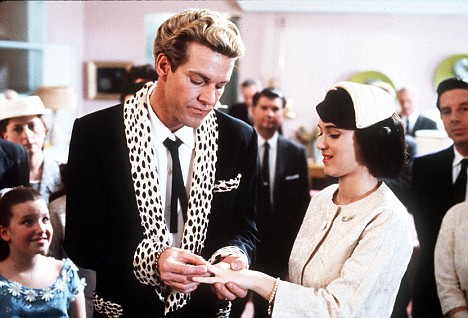
Great Balls of Fire is based on Myra Lewis' book "Great Balls of Fire: The Uncensored Story of Jerry Lee Lewis" which she co-wrote with Murray Silver. Since we're looking at Jerry Lee through the eyes of Myra, it means the movie starts with the first time she met Jerry Lee and continues through Jerry Lee's rise to stardom and subsequent fall from grace when he married her, his 13 year old cousin. Which also results in one on my favorite lines in the movie, when Myra (Winona Ryder) hears on BBC TV that it's been revealed that she's Jerry Lee's cousin, she says: "But we're second cousins, twice removed!"
I've read many times that people thought Dennis Quaid was over the top in the way that he "aped" Jerry Lee. I would beg to differ, since Jerry Lee in real life is an "over the top character", maybe Dennis didn't even go far enough.
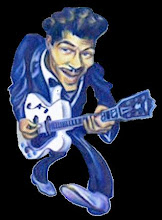
John Doe, Mojo Nixon, and Jimmy Vaughn all play members of Jerry Lee's band in the movie, plus John Doe portrays J.W., Myra's father. Other musicians we meet along the way: Elvis (Michael St. Gerard) who just HAPPENS to drop by Sun Studios twice, once when Jerry Lee is signing his contract and once in his army uniform (I'm assuming Elvis was leaving for Germany). Big Maybelle (Valerie Wellington) at a black juke joint and in the same club we see Piano Slim (Booker T. Laury). Chuck Berry (played by an uncredited actor) is in disagreement about who is going to close a show, Chuck's agent wins the argument, but Jerry Lee pulls out all the stops, including setting his piano on fire, and then tells Chuck..."Follow That Killer!". In real life, Chuck claims that Jerry Lee didn't use the word "killer"..I'll let you fill in the word that Chuck says he was called (a side note: Jerry Lee denies Chuck's claim). We also get Steve Allen playing Steve Allen and even though Steve was a noted rock and roll hater, I think he might have dug Jerry Lee because as a fellow pianist, he recognized the talent Jerry Lee had on the piano. Although I understand Dennis Quaid did some of the piano playing you see in the movie, Jason D. Williams did most of the close up keyboard work.
A trio of non-musicians were important to the film's storyline: Sam Phillips (Trey Wilson), "Daddy O" Dewey Phillips (Joe Bob Briggs, credited here with his real name John Bloom) and Alec Baldwin as Jerry Lee's cousin Jimmy Swaggart. Which brings me to another point, I think Swaggart was included to enable the movie makers to present the struggle a lot of early rock performers had between playing sacred or secular music (Little Richard being a prime example, but even Elvis never got too far away from his church roots). It's just my opinion, but I think you would have had to grown up here in The South (I'm referring to the 50s, 60s South) to understand the pull that can happen between these two factions within some people. There's definitely a fine line between Pentecostal Religious Music and Rock Music.
One of my favorite scenes is Jerry Lee driving to the school to pick up Myra, his song "High School Confidential" is playing on his car radio and evidently everyone's radio, because the whole student body starts dancing all across the school campus....all I could think was shades of Rock n Roll High School. Which brings me to my final thought on Great Balls of Fire: If you view this movie as some type of historical document, then you'll be disappointed. However, if you watch the movie looking for the spirit that was early rock and roll, I think you'll be mighty pleased.
Before I get into the review of Border Radio (BR), I want to relate my John Doe Story. A year or so back my wife and myself were out walking around the French Quarter in New Orleans. We were coming back up Decatur Street, when I saw a guy that looked liked John Doe. I remarked to my wife that I thought that was who it was and I guess he noticed this, since as we came up closer to him, he got that panicked looked that some people get when they think they're about to be accosted by a fan. I guess he breathed a sigh of relief, since I'm not the type of person to bug someone famous or even semi-famous. And yes it was John Doe, it seems X was playing a gig at The House of Blues that night.
I buy and sell videos all the time on EBAY and have had BR on VHS tape several times, just never got around to watching it. I assumed (and you know what they say about the word assume!) that this was a movie about a border radio station (ala Wolfman Jack), which seemed interesting, but the amount of movies that come through my possession are too many for me to watch more than a few; and my video checker has just enough time to check the first few minutes to be sure that they play correctly.
When browsing through Netflix, I saw that BR was on DVD (and a Criterion DVD to boot), so decided it was the time to finally check it out. Of course, BR doesn't have anything to do with a border radio station (remember what I said about assuming!!). Instead, BR is about a punk band that has broken up and Jeff (Chris D of The Flesheaters) has gone missing after himself, his roadie (Chris Shearer) and another band member (John Doe of X) broke into a safe in a club that didn't pay them and supposedly took some important books along with the money they stole. The other band member, Dave Alvin of The Blasters, wasn't involved in the robbery and he only appears briefly in BR. Jeff has left his wife and daughter alone and hightailed it to Mexico. The remaining band members all want to get Jeff and the cash and/or books back. That's pretty much the plot since the remainder of the movie consists of different scenes with Chris in Mexico or the other characters in the U.S. BR changes its direction back and forth from plot based to mockumentary interview style, never settling on one style to make a cohesive movie. The cast is credited with “additional dialogue and scenario”, but in an interview segment John Doe states that they would be given a scene and then told "make some stuff up and we'll shoot it", leading me to believe that the major part of the dialogue in this movie was all improvised.
I've gone back and forth on my feelings for this movie. While watching BR it was so slow that at times it was hard to stay awake, but after I watched the extras and found it was made by three film students (Allison Anders, Dean Lent, Kurt Voss) over a period of 4 years for a cost of $82,000, I thought that was a pretty remarkable feat; except then I remembered that Kevin Smith made "Clerks" for around $28,000 and shot his film in 21 days. While the long shooting period helps explain why the direction of the film changed from noir (the main character's name is Jeff Bailey and he flees to Mexico, a nod to Robert Mitchum's Jeff Bailey in "Out of The Past") to a mockumentary to a character study, it still didn't excuse the fact that this was just basically a bunch of well shot scenes that together made SOMEWHAT of a coherent film. I finally decided that it was a pretty good student film and I would just have to accept it for what it was.
Other musicians who can be seen in BR are Green On Red playing in the background in one club scene and Billy Wisdom and the Hee Shees seen playing in a studio setting. Two other musicians of note, both excellent in their roles, are Texacala Jones, lead singer of Tex and The Horseheads as the baby sitter and Iris Berry doing a great turn in the interview segments as a hanger-on/groupie fan.