Showing posts with label Elvis Presley. Show all posts

Sunday, April 13, 2014

SPEEDWAY


Speedway was Elvis' third appearance as a race car driver having previously had the same profession in Viva Las Vegas as Grand Prix driver Lucky Jackson, and in Spinout he played Mike Mcoy, part time race car driver and part time musician. While Viva Las Vegas is one of Elvis' best films, Speedway ranks more toward the bottom of Elvis' cinema output. The plot, which I know isn't the prime reason they made movies starring Elvis, concerns Elvis' business manager, Bill Bixby, misusing Elvis's funds until they get audited by the IRS. It seems Elvis owes Uncle Sam $150,000. Nancy Sinatra is an IRS agent assigned to Elvis's case to recoup the funds he owes.....need I say that a love interest blooms between the two? Oh yeah, there's some kind of subplot about a homeless guy with kids which is never fully developed, but allows the movie to include some cute little girls.


I guess the idea of using Nancy Sinatra as Elvis' love interest in Speedway would be equal to Ann-Margret in Viva Las Vegas. The problem is there wasn't much chemistry between Nancy and Elvis, plus Nancy just wasn't as talented in the singing and acting departments as Ann-Margret. I'm not trying to take anything away from Nancy, she definitely had some onscreen sex appeal and definitely could rock a pair of white go-go boots, but her acting wasn't even as good as Elvis' and that's a feat hard to accomplish. Even though her performance was good, the one song she was given to sing solo, "Your Groovy Self" , written by her long time collaborator Lee Hazlewood, had a great title, but unfortunately terrible lyrics.
 

Quentin Tarantino had his design team for Pulp Fiction view Speedway and the results can be seen in that film. The club Elvis hangs out in, cleverly called The Hangout (bet that took a lot of time to think up) features car bodies for booths. In the Jack Rabbit Slims club scene in Pulp Fiction, a similar type of car booth was used.  No dance contest at The Hangout, as in Pulp Fiction, but when the owner shines a spotlight on someone, they have to perform for the rest of the club. This, of course, made it easy to include a couple of more songs in the film. A couple of songs in Speedway turned out to be pretty good, especially "Let Yourself Go" and the finale "There Ain't Nothing Like A Song", plus I enjoyed the "full on" Broadway musical performance of "He's Your Uncle, Not Your Dad". When all is said and done, Speedway delivered what is was supposed to....Elvis singing some songs wrapped around a light plot. It just didn't do it as well as some of his other movies.

Friday, July 26, 2013

VIVA LAS VEGAS


Viva Las Vegas would be a pretty standard Elvis movie except for the presence of Ann-Margret, who obviously inspired Elvis to do some of his best film work. Elvis plays Lucky Jackson, a race car driver trying to raise enough money to buy a new engine for his car. Ann-Margret plays Rusty Martin, a swimming instructor at the hotel where Elvis is staying. Elvis tries to woo Ann-Margret and she resists these advances at first but, of course, she eventually falls in love with Elvis. 


In Viva Las Vegas, Elvis sings seven songs solo and has a duet with Ann-Margret on one song. Ann-Margret has two solo songs in the movie and The Forte Four have one song. I thought the stand-out songs were "Viva Las Vegas" (Elvis has an edge to his voice when singing this tune that really makes the song), "C'mon Everybody" and his duet with Ann-Margret "The Lady Loves Me". A few of the other songs were ok and, as usual with an Elvis movie, a few of the songs were just "filler". Supposedly, the scene where Elvis performs "Viva Las Vegas" was done in one unedited shot, the only time this ever happened in Elvis' movie career.


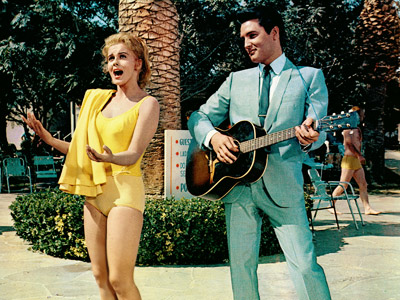
My mind wandered into the fantasy world of the movie as I wondered in the above scene, did Elvis have the short yellow jacket and Ann-Margret wore the dress to match OR did Ann-Margret have the yellow dress and Elvis said "Hey, I got a short yellow jacket to match."


It's rumored that Ann-Margret and Elvis had a love affair while making this film and I have no doubt this is what brought out the best in Elvis. Ann-Margret had only made a few movies before this one and Elvis turned out to be the better actor in the film. When Elvis and Ann-Margret have a scene together their chemistry exploded off the screen. They truly made a dynamic duo (take that Batman and Robin!). There are a few dull moments and a few silly moments in Viva Las Vegas, but they're few and far apart. I think the worst part of the movie, for me, was Ann-Margret's second dance number. I felt like I had already seen the same routine the first time she danced in the movie. 


This is one of my all time favorite Elvis movies and I imagine everyone has seen this film at some point in their lives, if not, do yourself a favor and rent it, buy it, or download it at your earliest chance.

Sunday, June 2, 2013

ELVIS: The MINISERIES


Elvis: The Miniseries was a made for TV special that covers Elvis' years from high school to his 1968 Comeback Special. It was produced with the cooperation of The Presley Estate and used master recordings of Elvis songs in the production. Jonathan Rhys Meyers (Tudors, Dracula) plays Elvis and Randy Quaid plays Col. Tom Parker with Camryn Manheim and Robert Patrick co-starring as Elvis' parents and Rose McGowan portrays Ann-Margret.


Along with Elvis and Ann-Margret, the miniseries also features actors portraying Scotty Moore, D.J. Fonatana, and Bill Black as members of Elvis' band and Chet Atkins as RCA producer, plus Wynonie Harris in a club scene. All these actors do a credible job, although Chet Atkin's part is so small to be almost unnoticeable. Saving the best for last, Rose McGowan shined in her part as Ann-Margret.


Jonathan Rhys Meyers looked like he was born to play Elvis and he was also good at mimicking Elvis' speech patterns and movements. Although the movie touted original master recordings, this actually turned out to be the worst part of the movie. Meyers lip synch is ok, but  each time he does a song it's so obviously Elvis' voice that it reminded me of only Elvis and it took me out of the movie. The movie seemed fairly accurate, but of course, there's some "whitewashing" going on. One of the most glaring examples is near the first of the movie, when three 1950s teenagers (Elvis and a couple of his buddies) sum up a very liberal worldly view on race relations. I won't even go into how nice and neat they made it look when Elvis started dating 14 year old Priscilla. Rose McGowan, as mentioned above, was a standout as Ann-Margret and it's too bad she wasn't in the movie more. Watching Elvis: The Mini Series, you probably won't find out anything about Elvis that you didn't already know, but it's still a pretty entertaining three hours and a good overview of Elvis' life from his teens up to The 68 Comeback Special.

Friday, March 29, 2013

LONELY STREET


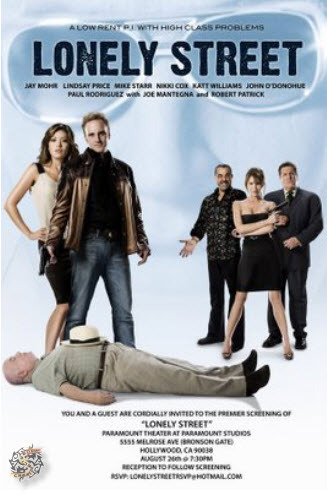
Lonely Street, the novel by Steve Brewer is a pretty good read. Lonely Street, the movie starring Jay Mohr is a pretty bad movie and not bad in a "so bad it's good" way, just bad in a suck-ass way. The author has stated he pictured Nic Cage in the lead role and while that would certainly have helped the movie tremendously, the direction and writing of Lonely Street is so terrible I don't think even Cage could have saved this film from being a stinker. 


I knew going into Lonely Street that the movie, as is the usual case, would not be as good as the book. However, first time writer/director Peter Ettinger changed the whole concept of the book making Lonely Street almost unrecognizable from its source material. The book is about private eye Bubba Mabry being hired to work security for a Mr. Aaron (Elvis) who is being tracked by tabloid magazines. Elvis wants to remain out of the public eye and needs to know who is watching him. The movie has Elvis ready for his big comeback, but on his own terms.


There's an abundance of bad jokes and bad acting, to go along with the bad writing and directing of Lonely Street, making really only one reason to watch this film - Robert Patrick (Terminator 2, The X-Files, etc) as Elvis. With some prosthetics added, his portrayal of what Elvis would look and act like at the age of 72 is uncanny.  He was so good, I thought I had been watching an Elvis impersonator until the credits rolled at the end. In a side note, Robert Patrick also starred as Elvis' father Vernon in the TV movie Elvis, so maybe he has a gift for playing elderly Presleys.


I can't imagine who would enjoy this movie, unless it's fans of Jay Mohr, and even then, they may just come away being embarrassed for him. My recommendation for Lonely Street is, if you want to see a good movie about an aged Elvis, then you should watch Bubba Ho-Tep 


Wednesday, October 13, 2010

WALK THE LINE


I've only seen a couple of biopics in which the lead actor was so able to meld their own personality with the subject they were portraying, they made it hard for me to see where one person ended and the other began. This was the case with Sissy Spacek in Coal Miner's Daughter, Gary Busey in The Buddy Holly Story, and adding to the list is Joaquin Phoenix in Walk The Line.


Walk The Line starts with Johnny Cash (Joaquin Phoenix) preparing to go on stage at Folsom Prison. When Johnny sees a table saw, it reminds him of the death of his older brother Jack and the movie flashes back to that traumatic event in 1944. The film then moves Johnny into adulthood with his service in the Air Force, where at an on-base showing of a documentary about Folsom Prison, Johnny gets the idea for one of his most famous songs, "Folsom Prison Blues".


Johnny returns to the United States, gets married, and has a very unsuccessful career as a door to door salesman. He forms a gospel band on the side, and when they finally get a chance to record at Sun Studios, things are a bust when they sing Sam Phillips a gospel song. Johnny mentions that he has a song he wrote and when he plays it for Phillips....as the old saying goes "it's history in the making".


During his early years we see Johnny on tour with Jerry Lee Lewis, Roy Orbison, and even the king himself, Elvis Presley. [A side note: Waylon Payne plays Jerry Lee in this film, the last time I saw Waylon Payne he was playing Hank Garland in Crazy....I kept thinking I was watching Waylon Payne playing Hank Garland playing Jerry Lee Lewis]. On one of these tours, Johnny's path crosses with June Carter's (Reese Witherspoon) and he is smitten from the start. Too bad for Johnny, because June won't have anything to do with a married man. Also, on these tours we see Johnny getting hooked on pills, explaining why he always wears black (Johnny: "Couldn't Find Anything Else") and where he came up with his sound (Johnny: "We'd play faster if we could"). Walk The Line continues showing us parts of Johnny Cash's life back up to his performance at Folsom Prison.


Other musicians of note in Walk The Line: Shooter Jennings has a couple of brief appearances playing his own dad, Waylon Jennings. Sandra Ellis Lafferty, as Mother Maybelle Carter, has a great scene when the family is trying to get Johnny off drugs and she chases a drug dealer away with a shotgun. Shelby Lynne plays a very convincing role as Johnny's mother in the early part of the movie.


One final small thing to look for in Walk the Line, right before Johnny decides to play Folsom and record a live album there (even though the record company didn't think it was a good idea) he's looking through a box of prisoners' letters. If you look closely, one of them is from Folsom prisoner Glen Sherley. This is the man who wrote Johnny's song "Greystone Chapel" about the chapel at Folsom Prison.


Tuesday, September 21, 2010

PROTECTING THE KING


The one thing to keep in mind when watching
Protecting The King (PTK) is that it is NOT about Elvis Presley, it's a movie about his stepbrother, David Stanley, and his relationship with "The Big E". I assumed before watching this movie that it was going to be a disaster, since it was directed and co-/written by David Stanley. PTK turned out to be an acceptable movie even if, at 94 minutes, it is still a mite too long.


I can sum up the movie pretty quick: Elvis was nice to David. Elvis took David on the road with him. The road corrupted David. Elvis took a lot of drugs. David slept with a
LOT of women (Letting us know that he slept with a LOT of women must have been very important for David, since that point is hammered home over and over.) Elvis dies from too many drugs. David sees the light and gets clean.


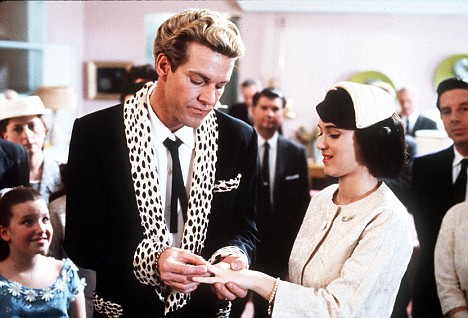
Peter Dobson was terribly miscast as Elvis (he looked more like Michael Madsen).
PTK would have been improved some, if they had cast someone with a little more believability (with all the Elvis impersonators, that shouldn't have been too hard). Of course, the word "ELVIS" was never used in the movie, he was always referred to as either "The King" or "The Boss" (I guess to avoid lawsuits). Along with not using Elvis' name, the members of his close entourage all have their names changed for the movie. The movie even changed RCA to RAC (which for some reason gave me a brain cramp every time I heard RAC in the movie)


IF you're interested in the life of David Stanley (as told by David Stanley) or somewhat interested in what life was like around Elvis then you will probably like PTK (You will still need to take into account that the movie is slanted to show David Stanley's interpretation of events.) IF you are looking for a movie about Elvis and don't have any interest in David Stanley, I would definitely recommend watching something else.

Sunday, August 22, 2010

ROCK AROUND THE CLOCK


Sam Katzman was well known for being able to get a fad (which rock and roll was considered to be at the time) to the big screen before the fad had faded away and also for being able to do it on the cheap. He is often criticized that a lot of the movies he produced had weak plots and bad acting. I personally think everyone owes him a debt of gratitude for capturing some of the early rockers and rhythm and blues singers on celluloid.
Rock Around The Clock was Katzman's first music exploitation movie and after the success of Rock Around The Clock, he produced more music exploitation movies using "rock and roll" (Don't Knock The Rock, Jukebox Rhythm, Get Yourself A College Girl), "calypso" (Calypso Heat Wave), "the twist" (Twist Around The Clock, Don't Knock The Twist), "folk music" (Hootenanny Hoot), "British Invasion" (Hold On with Herman's Hermits) and even a couple of Elvis Presley movies (Kissin' Cousins, Harum Scarum).


Rock Around The Clock is generally considered the first rock exploitation movie by Katzman or anyone else. It was made to capitalize on the success that the song,"Rock Around The Clock" had received as part of the soundtrack in the movie Blackboard Jungle. Although it's hard for us today to look at Haley and see a "rock and roll" performer, he was huge during the years of 1954-56. Around 1957 his popularity declined when Elvis and other artists came along, who not only "looked like rockers" but also seemed to have "rock and roll" embedded within themselves.


Rock Around The Clock's plot revolves around the birth of "rock and roll" and points you to Bill Haley as the originator of the sound. While we all know that's not true, the plot of the movie can only exist by accepting that premise. Steve Hollis (Johnny Johnston) tells members of a Big Band that he has been representing that "big band music" is washed up. The band fires him, after which Steve and one member of the band, Corny (Henry Slate), decide to drive to New York. Along the way they stop in a small town where they find the town listening and dancing to Bill Haley and His Comets. They can't figure out what type music they are listening to "since it isn't boogie, it isn't jive and it isn't swing, it's sort of a combination of all of them". Once they find out it's a music called "rock and roll" Steve sees the next big thing and wants to sign the band plus a brother/sister dancing duo (who will be required to show kids how to dance to "rock and roll").


The rest of Rock Around The Clock revolves around getting the band and dancers signed and onto a national stage. There's a subplot about a romance between Steve and the female dancer (Lisa Gaye) that causes some trouble with a big booking agent whose daughter (Alix Talton) wants to marry Steve. Once Steve finds out that they have been blackballed by the booking agent, he turns to an old friend, Alan Freed, to help them get a foothold on entertainment bookings and of course everything works out fine by the end of the movie.


Rock Around The Clock not only had performances throughout the movie by Bill Haley and The Comets, who it appeared did have a pretty good rockin' stage show, but also The Platters who sing "Only You" and "The Great Pretender", Tony Martinez and his band do four Latin numbers, and Freddie Bell and His Bellboys sing "We're Gonna Teach You To Rock" and "Giddy Up Ding Dong".


A last note about Freddie Bell and His Bellboys, they recorded a version of "Hound Dog" in 1955 and in 1956 Elvis (who was doing a not very successful Las Vegas appearance at the time) saw Freddie Bell and His Bellboys singing it in their Las Vegas show and was moved to record it himself. This is interesting to me on two levels: Freddie Bell and his group have always looked more like a lounge act than a "rock and roll" act to me, and also the fact that Elvis would eventually wind up many years later in Las Vegas singing "Hound Dog", the song that he had "discovered" there and made famous.

Wednesday, July 28, 2010

GREAT BALLS OF FIRE


Everybody has their own favorite director/actor combinations: Welles/Cotton, Scorsese/De Niro, Burton/Depp, Ford/Wayne, Hitchcock/Stewart, etc. Although they only made two movies together, the combination of McBride/Quaid produced two of my favorite movies: "The Big Easy" and "Great Balls of Fire".

Before you start writing angry comments about how dare I include this pair of names with the others previously mentioned, please don't think for a moment that I believe Jim McBride and Dennis Quaid are in the same league of those names first mentioned. However, there is no denying that I love their two collaborations and both have a place in my list of favorite movies.

Before I begin my review, a short personal story about Jerry Lee Lewis. My mother used to always attend the country shows put on here in Greenville, SC, by the local country music station, they were known as WESC Shindigs and would include a line up of different country artists. She usually had someone to go with her, but sometimes her concert companion wouldn't be able to attend and she would ask me to go with her. At one of these shows, Jerry Lee Lewis was the headliner (remember this was when the rock audience had lost interest in Jerry Lee and he had found a new audience with country fans). The first part of Jerry Lee's segment was a run through of his country hits and the audience reacted pretty much like they did with all the previous acts: seated and clapping along with the songs. In the second half of his act, Jerry Lee returned to his rock roots and started blasting away at the piano, kicking his piano bench away, playing standing up, playing the piano with the heel of his boot, etc. (if you've seen any of Jerry Lee on film, you know what I'm talking about). The auditorium turned into bedlam, people on their feet, people dancing in the aisles, people screaming, and best of all a couple of ladies even passed out!!! An unforgettable performance.


Great Balls of Fire is based on Myra Lewis' book "Great Balls of Fire: The Uncensored Story of Jerry Lee Lewis" which she co-wrote with Murray Silver. Since we're looking at Jerry Lee through the eyes of Myra, it means the movie starts with the first time she met Jerry Lee and continues through Jerry Lee's rise to stardom and subsequent fall from grace when he married her, his 13 year old cousin. Which also results in one on my favorite lines in the movie, when Myra (Winona Ryder) hears on BBC TV that it's been revealed that she's Jerry Lee's cousin, she says: "But we're second cousins, twice removed!"


I've read many times that people thought Dennis Quaid was over the top in the way that he "aped" Jerry Lee. I would beg to differ, since Jerry Lee in real life is an "over the top character", maybe Dennis didn't even go far enough.

John Doe, Mojo Nixon, and Jimmy Vaughn all play members of Jerry Lee's band in the movie, plus John Doe portrays J.W., Myra's father.
Other musicians we meet along the way: Elvis (Michael St. Gerard) who just HAPPENS to drop by Sun Studios twice, once when Jerry Lee is signing his contract and once in his army uniform (I'm assuming Elvis was leaving for Germany). Big Maybelle (Valerie Wellington) at a black juke joint and in the same club we see Piano Slim (Booker T. Laury). Chuck Berry (played by an uncredited actor) is in disagreement about who is going to close a show, Chuck's agent wins the argument, but Jerry Lee pulls out all the stops, including setting his piano on fire, and then tells Chuck..."Follow That Killer!". In real life, Chuck claims that Jerry Lee didn't use the word "killer"..I'll let you fill in the word that Chuck says he was called (a side note: Jerry Lee denies Chuck's claim). We also get Steve Allen playing Steve Allen and even though Steve was a noted rock and roll hater, I think he might have dug Jerry Lee because as a fellow pianist, he recognized the talent Jerry Lee had on the piano. Although I understand Dennis Quaid did some of the piano playing you see in the movie, Jason D. Williams did most of the close up keyboard work.


A trio of non-musicians were important to the film's storyline: Sam Phillips (Trey Wilson), "Daddy O" Dewey Phillips (Joe Bob Briggs, credited here with his real name John Bloom) and Alec Baldwin as Jerry Lee's cousin Jimmy Swaggart. Which brings me to another point, I think Swaggart was included to enable the movie makers to present the struggle a lot of early rock performers had between playing sacred or secular music (Little Richard being a prime example, but even Elvis never got too far away from his church roots). It's just my opinion, but I think you would have had to grown up here in The South (I'm referring to the 50s, 60s South) to understand the pull that can happen between these two factions within some people. There's definitely a fine line between Pentecostal Religious Music and Rock Music.

One of my favorite scenes is Jerry Lee driving to the school to pick up Myra, his song "High School Confidential" is playing on his car radio and evidently everyone's radio, because the whole student body starts dancing all across the school campus....all I could think was shades of Rock n Roll High School. Which brings me to my final thought on Great Balls of Fire: If you view this movie as some type of historical document, then you'll be disappointed. However, if you watch the movie looking for the spirit that was early rock and roll, I think you'll be mighty pleased.