Showing posts with label Chuck Berry. Show all posts

Thursday, June 20, 2013

ROCK, ROCK, ROCK

Rock, Rock, Rock is primarily a concert film molded around a very slight plot about Tuesday Weld (13 years old at the time) trying to get the right dress for the prom. Most of the songs in the movie are presented during two points in the movie: when Weld and her friend watch The Alan Freed Show on TV and when Alan Freed brings his show to the prom. There are a few other songs in the film that are incorporated as if the movie was a standard musical.


There's a pretty large line-up in Rock, Rock, Rock with notable music acts: Chuck Berry, The Moonglows, The Flamingos, Teddy Randazzo, Alan Freed & His Rock & Roll Band w/"Big" Al Sears, The Johnny Burnette Trio, Lavern Baker, and Frankie Lymon & The Teenagers. There are a few other minor acts: Cirino and The Bowties, Jimmy Cavallo and The House Rockers, and child singer Ivy Schulman. Tuesday Weld "sings" two songs, with her vocals supplied by Connie Francis.


My favorite performances in the movie were by Chuck Berry, Johnny Burnette Trio, and Frankie Lymon and The Teenagers. There's a little something in the film for everyone: Doo Wop Groups, Rock Groups, R&B singers, Pop singers, and as noted above, even a child novelty singer.  Rock, Rock, Rock moves at a pretty brisk pace, since in 85 minutes it manages to have all the music acts, the other musical performances and the storyline. Although the plot was silly (at least by today's standards), the movie is well worth watching for the great line-up of stars.

Wednesday, August 18, 2010

GO, JOHNNY, GO!


This movie is like many that came before it and many that would come after it: existing primarily to showcase a group of rock and roll performances, that are surrounded by a plot to hold things together. The best part of Go, Johnny, Go! is that Chuck Berry not only gets to perform but also gets to act. The film never makes it clear, but as far as we can tell, he is either Alan Freed's best friend or partner, since they are always hanging out together. Another plus is the lead actor, Jimmy Clanton, who can actually sing (not always the case in these movies); however his acting ability and character's attitude is on par with Elvis' in "Wild In The Country". Jimmy was from Louisiana and you can hear the influence of his home state in a couple of his songs in the movie, while his other songs in the movie are done in a typical teen ballad style.


The opening credits roll as Chuck Berry plays "Johnny B. Goode" in the background. Go, Johnny, Go! opens with Alan Freed having a stage show going on and we see The Flamingos singing a scorching version of "Jump Children". Johnny (Jimmy Clanton) is hanging out backstage with Alan Freed and Chuck Berry and when Johnny goes on stage to sing "Angel Face", Chuck gets Freed to tell him the story of how Johnny almost landed in jail instead of becoming a big star.


Go, Johnny, Go! then flashes back to when Johnny had got out of the orphanage to perform in a gospel group (did Clyde Edgerton watch this movie and get an idea for Killer Diller?). When the choir director leaves the room, Johnny sings "Ship On A Stormy Sea" and you can hear some of his swamp pop roots even in this song. The choir director returns and says he'll have to send Johnny back to the orphanage (Man! they don't cut you any slack at this church). Johnny instead sets out on his own and gets a job as an usher.


We see Johnny doing some ushering, but mostly rocking along to the acts on stage and this winds up getting him fired from his job. They do let Johnny stay on and see the rest of the show and even give him his own seat. During this segment of the movie we have performances by Harvey (Fuqua of The Moonglows) doing "Don't Be Afraid To Love Me", Jo-Ann Campbell singing "Momma Can I Go Out" and Eddie Cochran doing "Teenage Heaven". Freed tells the crowd he's looking for a new star who he will name Johnny Melody. Johnny, thinking this will be his big break, waits for Freed out back of the theater where he meets Julie (Sandy Stewart) who was in the same orphanage as him. He brushes her off telling her he has just enough money for a demo and no time for dating. When Freed finally comes out, Johnny gets the brush off as Freed tells him that the whole thing is just a publicity stunt.


The movie switches to Julie, who is also an aspiring singer, and she's in the recording studio singing "Playmates". Johnny arrives at the same studio and barely has enough to pay for studio time and desperately needs a backup female singer which, of course, Julie agrees to be. Johnny/Jimmy Clanton then sings " My Love Is Strong" (this song would fit great on any Swamp Pop collection). Johnny gets his song to Freed's office, but the only information he includes with his recording is that he is the future Johnny Melody. Chuck pushes for Freed to find out who Johnny really is but Freed is tired of fooling with the whole thing and goes off with Chuck to watch him perform on a TV show and we get to see Chuck doing "Memphis, Tennessee".


Johnny is hanging out with Julie at her adopted parents house watching Chuck on TV. Julie is trying to assure Johnny that he has plenty of time to make it by pointing out that Chuck probably didn't make it until he was 27 or 28 and Johnny delivers one of my favorite lines in the movie "Who wants to wait until they're middle-aged". Johnny explains to Julie that he's barely been making a living by playing his trumpet and this leads to Johnny playing his horn while Julie plays the piano. Her adoptive parents come home and we find out they're "hip" squares as the foursome take off for the "The Krazy Koffee Kup" to catch some late night tunes.


Alan and Chuck are already at the club and we get to see The Cadillacs do two staged performances "Jay Walker" and "Please Mr. Johnson" and Jackie Wilson do "You Better Know It". Chuck is still pushing for Freed to find Johnny and as luck (or a convenient plot twist) would have it, when Julie finally convinces Johnny to go talk to Freed, he has just left.


Freed goes back to the radio station and plays Johnny's song every 15 minutes waiting for him to call in and identify himself. Unfortunately, Johnny is so mad at Freed that he refuses to listen to Freed's show and doesn't hear the announcement. Johnny wants to know what Julie wants for Christmas and she tells him that she wants him to have a hit record, but he pushes for a real present and she tells him about a pin she saw at a jewelry store. Johnny tries to pawn his horn but has no luck and decides to smash in the jewelry store window and steal the pin (conveniently there are a pile of bricks nearby).


Julie, alone in her room, is thinking about Johnny and sings "Heavenly Father", after which she turns on the radio and hears Johnny's song and that Freed is looking for him. She rushes to the studio, but Freed has left and gone to an "after hours" jam session at Henry's Hideaway. Here we get to see Freed on drums backing up Chuck singing "Little Queenie". After Freed gets off stage, Ritchie Valens (in his only film appearance) sings "Ooh My Head". Julie finds Freed and tells him about Johnny and they both go on a search for him. Freed convinces the police that he is drunk and is the one who broke the window. Instead of going to jail, Johnny goes on to become a big star and the movie returns us to the present where we also find that Johnny will be marrying Julie in the near future.

Wednesday, July 28, 2010

GREAT BALLS OF FIRE


Everybody has their own favorite director/actor combinations: Welles/Cotton, Scorsese/De Niro, Burton/Depp, Ford/Wayne, Hitchcock/Stewart, etc. Although they only made two movies together, the combination of McBride/Quaid produced two of my favorite movies: "The Big Easy" and "Great Balls of Fire".

Before you start writing angry comments about how dare I include this pair of names with the others previously mentioned, please don't think for a moment that I believe Jim McBride and Dennis Quaid are in the same league of those names first mentioned. However, there is no denying that I love their two collaborations and both have a place in my list of favorite movies.

Before I begin my review, a short personal story about Jerry Lee Lewis. My mother used to always attend the country shows put on here in Greenville, SC, by the local country music station, they were known as WESC Shindigs and would include a line up of different country artists. She usually had someone to go with her, but sometimes her concert companion wouldn't be able to attend and she would ask me to go with her. At one of these shows, Jerry Lee Lewis was the headliner (remember this was when the rock audience had lost interest in Jerry Lee and he had found a new audience with country fans). The first part of Jerry Lee's segment was a run through of his country hits and the audience reacted pretty much like they did with all the previous acts: seated and clapping along with the songs. In the second half of his act, Jerry Lee returned to his rock roots and started blasting away at the piano, kicking his piano bench away, playing standing up, playing the piano with the heel of his boot, etc. (if you've seen any of Jerry Lee on film, you know what I'm talking about). The auditorium turned into bedlam, people on their feet, people dancing in the aisles, people screaming, and best of all a couple of ladies even passed out!!! An unforgettable performance.


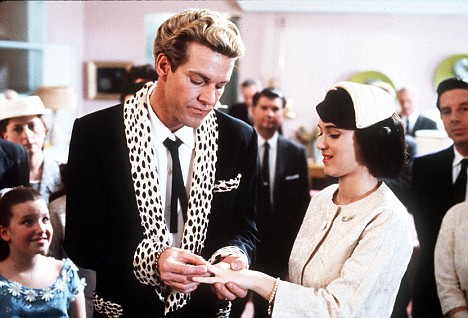
Great Balls of Fire is based on Myra Lewis' book "Great Balls of Fire: The Uncensored Story of Jerry Lee Lewis" which she co-wrote with Murray Silver. Since we're looking at Jerry Lee through the eyes of Myra, it means the movie starts with the first time she met Jerry Lee and continues through Jerry Lee's rise to stardom and subsequent fall from grace when he married her, his 13 year old cousin. Which also results in one on my favorite lines in the movie, when Myra (Winona Ryder) hears on BBC TV that it's been revealed that she's Jerry Lee's cousin, she says: "But we're second cousins, twice removed!"


I've read many times that people thought Dennis Quaid was over the top in the way that he "aped" Jerry Lee. I would beg to differ, since Jerry Lee in real life is an "over the top character", maybe Dennis didn't even go far enough.

John Doe, Mojo Nixon, and Jimmy Vaughn all play members of Jerry Lee's band in the movie, plus John Doe portrays J.W., Myra's father.
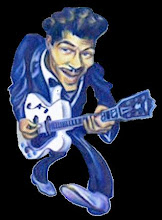
Other musicians we meet along the way: Elvis (Michael St. Gerard) who just HAPPENS to drop by Sun Studios twice, once when Jerry Lee is signing his contract and once in his army uniform (I'm assuming Elvis was leaving for Germany). Big Maybelle (Valerie Wellington) at a black juke joint and in the same club we see Piano Slim (Booker T. Laury). Chuck Berry (played by an uncredited actor) is in disagreement about who is going to close a show, Chuck's agent wins the argument, but Jerry Lee pulls out all the stops, including setting his piano on fire, and then tells Chuck..."Follow That Killer!". In real life, Chuck claims that Jerry Lee didn't use the word "killer"..I'll let you fill in the word that Chuck says he was called (a side note: Jerry Lee denies Chuck's claim). We also get Steve Allen playing Steve Allen and even though Steve was a noted rock and roll hater, I think he might have dug Jerry Lee because as a fellow pianist, he recognized the talent Jerry Lee had on the piano. Although I understand Dennis Quaid did some of the piano playing you see in the movie, Jason D. Williams did most of the close up keyboard work.


A trio of non-musicians were important to the film's storyline: Sam Phillips (Trey Wilson), "Daddy O" Dewey Phillips (Joe Bob Briggs, credited here with his real name John Bloom) and Alec Baldwin as Jerry Lee's cousin Jimmy Swaggart. Which brings me to another point, I think Swaggart was included to enable the movie makers to present the struggle a lot of early rock performers had between playing sacred or secular music (Little Richard being a prime example, but even Elvis never got too far away from his church roots). It's just my opinion, but I think you would have had to grown up here in The South (I'm referring to the 50s, 60s South) to understand the pull that can happen between these two factions within some people. There's definitely a fine line between Pentecostal Religious Music and Rock Music.

One of my favorite scenes is Jerry Lee driving to the school to pick up Myra, his song "High School Confidential" is playing on his car radio and evidently everyone's radio, because the whole student body starts dancing all across the school campus....all I could think was shades of Rock n Roll High School. Which brings me to my final thought on Great Balls of Fire: If you view this movie as some type of historical document, then you'll be disappointed. However, if you watch the movie looking for the spirit that was early rock and roll, I think you'll be mighty pleased.


Tuesday, April 13, 2010

AMERICAN HOT WAX


This movie is long out of print and never officially released on DVD. I say officially, since every bootlegger seems to have a copy for sale. Luckily, I taped mine off HBO many years ago and have watched it several times over the years.

American Hot Wax revolves around Alan Freed (Tim McIntire) just before the payola scandal and his last live Rock 'n' Roll Show at The Paramount Theatre.

Tim McIntire doesn't really look like Alan Freed, but he occupies his role so completely, you will believe that he is Alan Freed. As a matter of fact, every actor in American Hot Wax is good and this includes a cast as diverse as Jay Leno as Freed's driver, Fran Drescher as Freed's secretary, Laraine Newman as a sort of Carole King/Ellie Greenwich character, Jeff Altman as a music manager, and Richard Perry as a record producer.

One of the stand out actors, besides McIntire is Moosie Drier as Artie, the head of the Buddy Holly Fan Club. He has the most touching scene in the movie when he's talking to Freed about Holly. I found a clip (with Spanish subtitles) that I am including below.

American Hot Wax is a "busy" movie, there's people moving and talking and music playing almost from start to finish. This creates a feeling of excitement in the viewer that goes well with the rock 'n' roll soundtrack. Robert Altman has nothing on the director of American Hot Wax, Floyd Mutrux, when it comes to handling multiple characters at the same time.

While Floyd Mutrux may not be a well known name, he is well known among movie cultists. Not only did he direct American Hot Wax, but he also directed the cult movies "Aloha Bobby and Rose" and "The Hollywood Knights" plus IMDB shows him as an uncredited writer on "Two Lane Blacktop"

Besides all of the background music in American Hot Wax, the movie also contains performances by Chuck Berry, Jerry Lee Lewis, Screamin' Jay Hawkins and Frankie Ford.

American Hot Wax is not historically accurate and if you view the movie trying to put people, songs, and places into correct chronological order, you're going to be disappointed. However, if you want to watch a movie that will give you the feel and excitement of 1950s rock, then American Hot Wax is for you.