skip to main |
skip to sidebar
Scared Stiff turned out to be a major disappointment for me. I bought this video sometime back and held off watching it until Halloween, since it was a remake of The Ghost Breakers starring Bob Hope and Paulette Goddard, which was really a great movie.
Through a series of mis-adventures, Dean Martin and Jerry Lewis wind up on a boat headed for Cuba and agree to help a damsel in distress, Lizabeth Scott, with a castle she has inherited. Is the castle really haunted or is there some other reason people don't want her to assume possession? Well, you can probably guess the answer to that question.
Produced by Hal Wallis with additional dialogue provided by Ed Simmons and Norman Lear, this film looked like it would be a sure winner. While Dean Martin was good as the smooth swinging lover boy character and Jerry Lewis was probably good as the idiot character, that's where my problem lies. I just don't get Jerry Lewis (maybe I should have been born in France). I assume Lewis' man-child acting must amuse plenty of folks, the humor is just lost on me. Scared Stiff was a long drawn out unfunny film for me with only a few bright spots.

Dino sings a couple of tunes, as does Carmen Miranda (in this her final film) and although I really was just in a hurry to get to the end of the film, these musical interludes were better than most of the movie. In a uncredited part, Frank Fontaine (Crazy Guggenheim from the Jackie Gleason Show), pops up as, what else, a drunk and this is probably the best comedic scene in the film. However, the very brightest spot in Scared Stiff was a brief cameo by Bob Hope and Bing Crosby, in their few seconds on screen, they out shined Martin and Lewis by a mile.
All I knew about Searching For Sugar Man before I watched the movie, was it was highly recommended as a great music documentary. A Detroit musician known by the singular name Rodriguez records two albums in the early 1970's, which go nowhere in the U.S., but in a strange twist of fate, they become two of the most popular LPs in South Africa. Not only is there no information about the artist, but the legend in South Africa is that Rodriguez committed suicide on stage. Back in the U.S., Rodriguez thinking his music career is over goes back to his manual labor job of demolishing homes. The story could have ended there, except in the late 1990's, a couple of his South African fans decided to see what they could find out about this mysterious artist and to their amazement found him alive and well and living in Detroit.

This first part of the documentary is laid out with such detail to the mystery, that after the discovery of the Rodriguez in Detroit, the movie started to drag momentarily for me, until Rodriguez turned out to be everything you could want in a forgotten hero. His first visit to South Africa (where everyone believed he would turn out to be an imposter) is such a triumph that you can feel it through your TV screen.

Now for a couple of mild quibbles I have with the film. While the filmmaker tries to make a case that Rodriguez was another Bob Dylan, I just didn't get the same feeling. What I did hear was a "heavier" Jim Croce (and that's not a bad thing in my opinion). [On a side note, I felt his first LP was the stronger of the two, with the second one being over-produced.] My other problem, and one I didn't find out until doing some online research after watching the movie, was that Rodriguez was also popular in Australia and had toured there a couple of times before going to South Africa. So, although, Searching For Sugar Man is basically about the relationship between the music, the artist, and South Africa, omitting the Australian tours made the initial tour of South African concert a little less important in retrospect, however, I realize this was done to make the movie have more impact on the viewer.
My favorite fictional depiction of Brian Jones is in the film, My Dinner With Jimi (which is also an excellent movie). In that film, he's portrayed as a laid back, music lover musician, which is the how most of us probably want to remember him. My least favorite portrayal of Brian Jones is in this film, Stoned, known in The UK as The Wild and Wycked World of Brian Jones.
A lot of this has to do with my disappointment in Stoned not giving the viewer much of a clue into what made Brian Jones who he was. The dynamics of The Rolling Stones as a group and how they rose to fame is only brushed upon in some brief flashbacks. (These flashbacks are actually the best part of the film.) Instead, we get a portrait of a drug addled musician corrupting a carpenter/handyman, Frank Thorogood, who is hired to "look after" Jones. The handyman, who never realizes that he is out of his depth, slowly descends into the "rock lifestyle" and this film represents him as the killer of Jones.

Stoned features Leo Gregory as Brian Jones and unfortunately he bears little resemblance to Brian, but instead just looks like an actor in a bad wig. Gregory is much to "gaunt" to portray Brian, and in fact in many shots, he reminded me more of David Spade. Oddly, the actors playing the other Rolling Stone members all bear a passing resemblance to their real life counter points. Speaking of casting, David Morrisey as Rolling Stones "minder/fixer" Tom Keylock, is the standout actor in the film. The real Keylock was a consultant on the movie and while he named Thorogood as the killer in real-life, he himself was always suspected as being the actual murderer of Jones.

Probably the best part of Stoned is the soundtrack, which features only one Rolling Stones contribution, Robert Johnson's "Love in Vain". The rest of the soundtrack features Robert Johnson himself, plus songs from Jefferson Airplane, White Stripes, The Bees, Kula Shaker, Traffic and 22-20's. If nudity offends you, then be forewarned there are lots of topless women and full frontal male nudity in Stoned. None of this offended me, I was more offended by this terrible waste of a biopic, Brian Jones deserved much better.
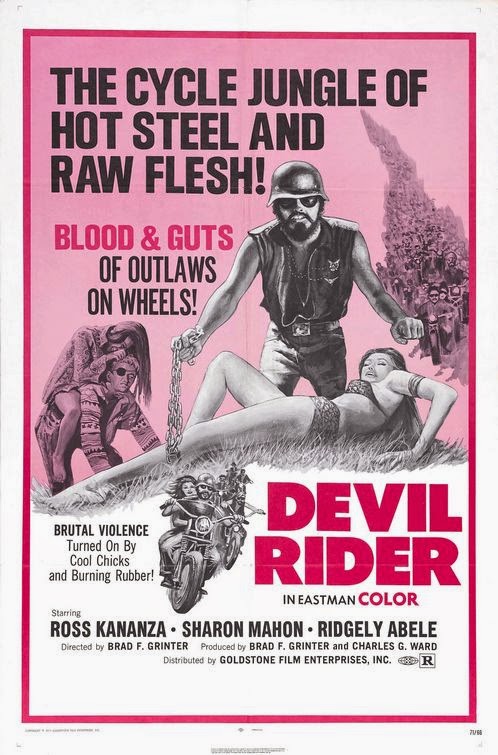
One night I was in the mood for an Outlaw Biker Film and while searching through youtube I found an obscure, out of print film called Devil Rider and decided to give it a try. If you wonder why it's showing up here on Gonna Put Me In The Movies, well we'll get to that in just a bit. Devil Rider turned out to be much worse than even I expected it to be....but it was that kind of bad movie that's so bad you start enjoying it the more you watch. The acting in Devil Rider ranged from "look ma, I'm saying stuff and I'm in a movie" to community theater level to a few people who could "actually act". The poster above makes this film look 100 per cent better than it really was.

The basic story is about a young girl whose boyfriend is too busy giving karate lessons to pay attention to her. On her own and in a fit of boredom she joins up with a biker gang. When she doesn't show back up at home, her parents hire a private detective to track her down. The detective is so inept that he "thinks" he is disguising himself as a fellow biker and tries to infiltrate the gang. His disguise is SO BAD (like something you rambled through a closet and put together) that he is immediately found out and has to be rescued by the karate boyfriend when he comes for "his woman". The real highlight of the film is the karate boyfriend, who looks and acts like he's Napoleon Dynamite, and when I think about it, Devil Rider could have been a prequel to that movie. The private detective (seen above in his "disguise") could even be Pedro's father.

Now, getting to why Devil Rider is showing up on this blog. The film opens with a nice psych instrumental, "The Wind", played by Heroes of Cranberry Farm (I swear I'm not making that name up) who are playing in, what I assume, is a city park (this same location appears to be where the bikers hang out and where a majority of the action takes place). The Heroes of Cranberry Farm, in an earlier incarnation, were a Florida garage band known as The Squiremen (IV). There's some great photos and other interesting information about this group at the following link: The Limestone Lounge. If you can't tolerate really bad movies, the best thing is, you can catch the first few minutes of Devil Rider and see the Heroes of Cranberry Farm without having to watch any more of the movie. If you like a really bad movie, then this film will be right up your alley.
Speedway was Elvis' third appearance as a race car driver having previously had the same profession in Viva Las Vegas as Grand Prix driver Lucky Jackson, and in Spinout he played Mike Mcoy, part time race car driver and part time musician. While Viva Las Vegas is one of Elvis' best films, Speedway ranks more toward the bottom of Elvis' cinema output. The plot, which I know isn't the prime reason they made movies starring Elvis, concerns Elvis' business manager, Bill Bixby, misusing Elvis's funds until they get audited by the IRS. It seems Elvis owes Uncle Sam $150,000. Nancy Sinatra is an IRS agent assigned to Elvis's case to recoup the funds he owes.....need I say that a love interest blooms between the two? Oh yeah, there's some kind of subplot about a homeless guy with kids which is never fully developed, but allows the movie to include some cute little girls.

I guess the idea of using Nancy Sinatra as Elvis' love interest in Speedway would be equal to Ann-Margret in Viva Las Vegas. The problem is there wasn't much chemistry between Nancy and Elvis, plus Nancy just wasn't as talented in the singing and acting departments as Ann-Margret. I'm not trying to take anything away from Nancy, she definitely had some onscreen sex appeal and definitely could rock a pair of white go-go boots, but her acting wasn't even as good as Elvis' and that's a feat hard to accomplish. Even though her performance was good, the one song she was given to sing solo, "Your Groovy Self" , written by her long time collaborator Lee Hazlewood, had a great title, but unfortunately terrible lyrics.

Quentin Tarantino had his design team for Pulp Fiction view Speedway and the results can be seen in that film. The club Elvis hangs out in, cleverly called The Hangout (bet that took a lot of time to think up) features car bodies for booths. In the Jack Rabbit Slims club scene in Pulp Fiction, a similar type of car booth was used. No dance contest at The Hangout, as in Pulp Fiction, but when the owner shines a spotlight on someone, they have to perform for the rest of the club. This, of course, made it easy to include a couple of more songs in the film. A couple of songs in Speedway turned out to be pretty good,
especially "Let Yourself Go" and the finale "There Ain't Nothing Like A
Song", plus I enjoyed the "full on" Broadway musical performance of "He's Your Uncle, Not Your Dad". When all is said and done, Speedway delivered what is was supposed to....Elvis singing some songs wrapped around a light plot. It just didn't do it as well as some of his other movies.
A motorcycle gang, The Savage Seven, invade an Indian shanty town and at different points in
the film the Indians and the Cycle Gang are either friends with each
other or they're fighting each other. When one of the company store employees rapes and kills an Indian
girl the blame is put on the Savage Seven. This starts an all out fight
with the Savage Seven, where they take the place of the Indians attacking
from above (as seen in so many Western films) and the Indians are those holed up in a "fort", or in this case the shanty town. This is when The Savage Seven
finally gets in the groove with a fifteen minute fight, where the
stunt director must have been told to pull out all he's got, since
there are people falling off buildings, crashing bikes, running cycles
through cardboard boxes, a person catches on fire, knife fights, guns
shooting, dynamite exploding and probably some other things I've
forgotten about.

The Savage Seven was a co-production between American International Pictures and Dick Clark Productions. It's an entry in the outlaw biker films, which were primarily made from the mid 1960s through the early 1970's. Although, Quentin Tarantino lists the movie as #19 on his top 20 Grindhouse Films, I found it to be only mildly entertaining with most of the fun coming at the very last of the movie when the big fight occurs. Robert Walker Jr. is painfully miscast in The Savage Seven as the leader of the Indians. It's never explained why this white boy looks so different from his brethren, except once when he's called Johnny Blue-Eyes.
Also, of slight interest, this movie marked the debut of Penny Marshall
as one of the waitresses who's really into the motorcycle gang members.

Most likely due to Dick Clark being involved, Duane Eddy (a close
friend of Clark's) was given a part in the film as Eddie, one of the
motorcycle gang members. I'm assuming that Eddy decided to "talk tough"
when delivering his lines, but unfortunately this caused some of
his words to be almost intelligible. Eddy is sometimes hard to pick out when
watching the film, but if you want to spot him, he's the one wearing the Rebel cap (sort of like the ones you buy at tourist
shops in the Great Smoky Mountains). Strangely, there are no Duane Eddy instrumentals on the soundtrack; however, the soundtrack does contain one song by Cream and two songs by Iron Butterfly. I personally found this movie mediocre in the field of biker films, but others may be much more enthralled than I was.
There's really only one reason to watch The Monkey's Uncle, unless you're a big fan of Annette's, Tommy Kirk's, or Monkeys. Luckily for those not interested in any of the aforementioned, you can catch the real reason to watch The Monkey's Uncle in the first few minutes of the movie. That's when Annette and The Beach Boys duet on the title song....heck you don't even have to watch the movie at all, since that clip is on Youtube.

The title tune is a catchy little number written by The Sherman Brothers, who wrote many of Annette's songs. The Beach Boys look like they're having fun performing with Annette, and Brian Wilson has said it was a real thrill. Mike Love even gets to do a little bit of dancing with Annette. I'm not sure all of "the boys" thought it was as thrilling as Brian, if you check out the studio photo below. Dennis appears to be wishing he was somewhere else, while Carl studies the floor and Mike appears to be using his time to study the bored Dennis and Carl. Only Brian and Al Jardine appear to be engaged in the process.

The rest of the film is made up of what is basically three different movies. First, we have Tommy Kirk becoming the guardian for Stanley, the monkey, so he can raise him in his home. Kirk uses sleep learning on the monkey, which leads into the second part of the movie, where Kirk uses the same methods on some "not so bright" football players to enable them to pass their exams. After that The Monkey's Uncle moves into its third act, with Kirk trying to win a $10 million dollar endowment for the college, if he can prove a man can fly on his own power.

The movie isn't bad and some of the plot for the film was obviously taken from "the beach party films", which were still pretty popular at the time. Not only does The Monkey's Uncle have the club scene at the first, but the first part of the film also has Annette talking marriage, pouting when Kirk doesn't show her enough attention, and jealousy over the monkey's baby sitter becoming too chummy with Kirk....all of these things could have been part of the plot of any of Annette's "beach party films". About half way into the film, most of this is dropped and you get your basic Disney family movie. So check out the first of the movie for The Beach Boys and Annette's song, and if you've got nothing better to do and you're in the mood for some mindless entertainment, stick around for the rest of the film